
Benjamin Didier Banlock: “We have players and chessboards. All that remains is to add coaches!”
We are globally well acquainted with black athletes and sportsman for basketball, sprinting, or Formula 1. But what about chess? “Maybe they do not have expertise in it or right muscles for chess” Soviet grandmasters travelling through Africa as instructors used to joke about. Meanwhile, Cameroon, has always been associated with football—fame for the charming Roger Milla, the oldest goalscorer in World Cup history, and Nepomnyashchy, the coach who created the “Italian miracle” by leading the Cameroon national team to the World Cup quarterfinals for the first time in history. Valery Kuzmich, who immediately became a national hero on the continent, is also a quite good chess player.
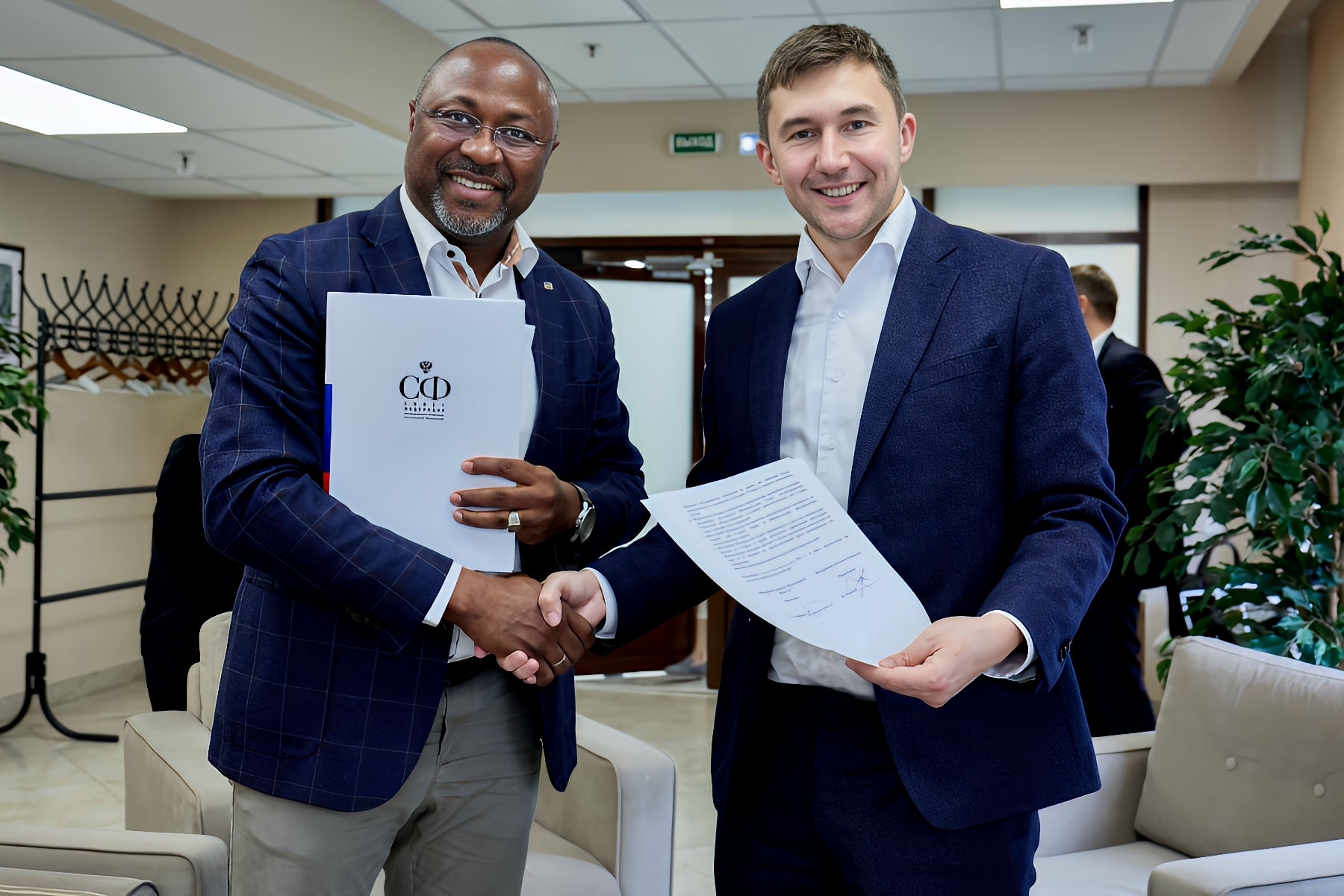
What do all these chess-and-football associations have to do with it? It is very simple: Mr. Banlock has arrived in Russia on a business visit, and he recently became the president of the Cameroon Chess Federation. For Benjamin Didier, the trip to Moscow is one of his first mission for his new role and is by no means coincidental. He has been involved in the chess world for two decades and knows very well where the “centers of strength” are. In 2010, he took part in his first Chess Olympiad in Khanty-Mansiysk and knows Russian chess firsthand. He even learned Russian for this purpose.
Unlike many of his continental colleagues, Banlock is remarkably calm and balanced. He peaks thoughtfully and deliberately, maintains intent eye contact, and has a firm handshake. He processes a deep understanding of the challenges facing chess in both his country and in the region—and he knows exactly how to address them, as well as who can help him succeed!
Q: Let’s start with the question I feel compelled to ask, and I hope it won’t offend you. Do you have an explanation for why African chess players generally lag behind players from Europe, America, or Asia in performance?
A: “There is no need to apologize; it is not offensive at all. This is the reality, and unfortunately it is one we have to accept. In my view, the main reason is culture – specially the culture of chess. We simply do not have one. We do not have the cultural foundation that has developed in Europe, America, and, in recent years, Asia… Most of my compatriots simply do not know what this game is! If things were different, I think the gap would not be so huge. Few would dispute that Africa is more commonly associated with athleticism, physical sports, and football rather than chess. To change this, we need frequent opportunities to meet stronger players, to compete, and to raise a generation that is not just taught to run and jump fast, but to play chess.
We are open to chess just like anyone else, but I cannot say there are any clearly defined centers on the continent. Perhaps the northern countries – like Egypt, Algeria, Tunisia, and Morocco – are slightly better positioned because of their proximity to Europe, but even there, player numbers are low and major tournaments are rare.
Another issue is poverty. Without financial backing, there are no classes, no coaches, no travels, and therefore no opportunity for systematic progress and development. In fact, all the African players you know are self-taught—individuals who willed themselves to success. Speaking from personal experience, I know how hard it is to succeed… I can say quite honestly that in the next 100 or 200 years there certainly will not be a world chess champion from Africa. If we are very lucky, perhaps in 50 years we might begin to shift our sports culture. But before then? – it is simply impossible.
“Right now, with the leadership of the Moscow Region Chess Federation, we are discussing opportunities that can help both Cameroon and all of Africa… This is very important for us. We are exploring different possibilities – bringing coaches to us, organizing systematic work… That would make it possible to raise that very African player whom others will follow. We want to create a wave!
“We will move toward our big goal in small steps. When you do not have a champion, no one will follow you. What is there to talk about? We live in the modern world – if people do not see a change in their financial situation, they will do nothing. Yes, we love chess, but if we do not earn money from it, sooner or later our interest will fade. People need to eat! What can you do? In Africa, that formula works even more starkly than in other parts of the world.
“With football, it works very well. Many people try because they understand that if they succeed, they will live well. But I understand that we need to be passionate enough to change this. I truly believe we can!
Q: “Do you see countries like Uzbekistan, and earlier Azerbaijan, as role models – countries that were not successful in other sports but invested heavily in chess and achieved striking results?
A: “Yes, of course. It is not always an ideal model, but if you have a president who loves chess, or a federation supported by wealthy people, you can get good results. Unfortunately, that is not our case. I would not say we have no state support at all, but it does not reach that level yet. For us, the school must be at the main center.
“In my view, the difference between people lies only in two things: where you were born and the culture you raised in. If you are born in Siberia, you adjust to that specific environment, and it shapes how your mind develops from day one. If you take a child born in Norway and send him to Africa, he will probably not become a great chess player! And if you take a child from Africa and place him in Norway, giving him the same training as Magnus Carlsen, he may have potential. It all depends on where you are and what culture surrounds you. Skin color is not essential; it does not affect mentality.
“Take Sindarov, for example – a young guy who crushed everyone at the Candidates Tournament. Why? And then we look at what has been done in Uzbekistan over the last five to seven years: the massive finalcial investment, how many tournaments were held, how many coaches were brought in. We look more broadly and see Abdusattorov, Yakubboev, and other players! Decades ago, we saw only Russians, Americans, and Europeans. Now there are Indians, Chinese, Uzbeks, and players from other smaller countries.
Q: Do you want Cameroon among them?
A: “Why not? Everything depends on timing and the effort we invest. Right now, there is no single country that stands head and shoulders above the rest. There is no USSR or Russia leaving no chances for competitors. There was Botvinnik, Tal, Spassky, then Karpov, Kasparov, Kramnik… I don’t think we will ever see a single nation dominate like that again. Carlsen came and destroyed everyone! There was Fischer, and no one could move. Now everyone has a chance; it all comes down to having a vision for the future and investment in chess.
Q: “Do you think you can handle such a global goal?
A: “I want to try. To raise a professional player, you need funding. At minimum, $20,000 to $30,000 a year for coaching, travel, and tournament expenses. I do not think that is an impossible goal for people in Africa…
“It just takes time! I was elected federation president only recently, 45 days ago. But I am already in Moscow to sign an agreement with the Moscow Region federation! I will seek help and support from other strong chess federations too – all over the world. I have a lot of energy and desire to develop chess at home, to find and bring strong coaches and methods, and to build infrastructure.
“We have players, and we have chessboards. What we need are coaches! We will be the first nation in Africa to launch such a program. I think representatives of other countries will follow us, and I very much hope that in ten years from now you will no longer have to ask the question that began this conversation…”